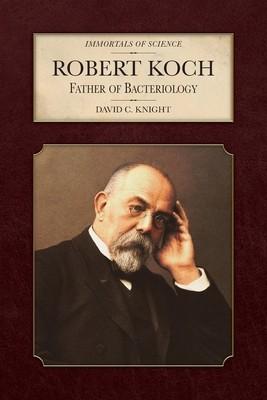
Robert Koch: Father of Bacteriology
Illustrated by Schrotter, Gustav
No other scientist has so aptly earned the title of "father" of his branch of science than Robert Koch. While Pasteur is regarded as the greatest applied becteriologist, it was Koch who first perfected the pure techniques of cultivating and studying bacteria. When Koch succeeded in isolating the dreaded anthrax bacillus, he became the first to prove that a specific bacterium was the cause of a specific disease. He also developed four famous rules —still in use today —for relating one kind of bacteria to one kind of disease. Later, he succeeded in growing pure cultures of bacteria, an essential technique in modern bacteriology. In 1882, Koch astounded the scientific world by first isolating the tubercle bacillus —the cause of tuberculosis. Later he discovered tuberculin, a substance used in diagnosing tuberculosis today. A tireless worker, Koch went on to save thousands of lives, both human and animal, through his investigation of Asiatic cholera, sleeping sickness, malaria, Texas fever, rinderpest, and Rhodesian red water fever.
- Publication Date
- 1961
Sources & edition guidance
Book descriptions
Book descriptions are drawn from a variety of publisher, jacket, bookseller, library, and bibliographic sources, and may be edited for clarity.
Illustrators
We have provided at least one recommended illustrator for each applicable book, though other excellent options may exist.
Content guidance
- Reading level
- Upper Elementary, Middle Grade
- Content warning
- None
Book tags
- Series
- Immortals of Science
- Timeline
- 19th Century
- Genre
- BiographyNon-Fiction
- Format
- Chapter Book
- Culture
- Europe
Loading related books…
Loading reviews…