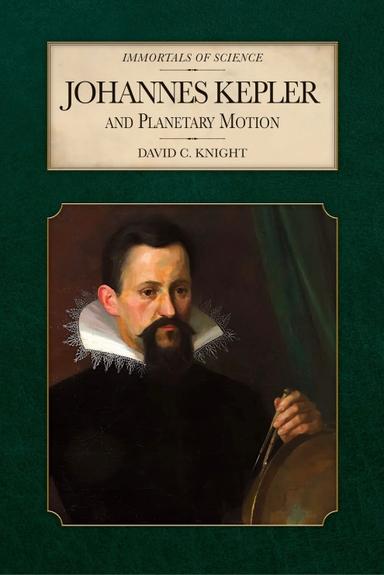
Johannes Kepler and Planetary Motion
Johannes Kepler's gifted astronomical discoveries forged one of the solidest links in the chain of scientific history. It was he who strengthened the incomplete Copernican cosmological theories by working out the age-old riddle of how the planets really move. And it was through a knowledge of Kepler's Planetary Laws that Isaac Newton was able to formulate his Law of Universal Gravitation. One of the warmest personalities in the entire history of science, Kepler had to overcome many obstacles —religious intolerance, poverty, petty politics, frail health, ceaseless wars. His mother's trial as a witch impeded his work for years. He had to earn his living largely by making calendars and casting horoscopes. Yet he came into contact with Emperors and the highest nobility, among them the great generalissimo of the Thirty Years' War, Wallenstein. Certainly his collaboration with the Danish observer, Tycho Brahe, is one of the most fascinating chapters in the history of science.
- Publication Date
- 1962
Sources & edition guidance
Book descriptions
Book descriptions are drawn from a variety of publisher, jacket, bookseller, library, and bibliographic sources, and may be edited for clarity.
Content guidance
- Reading level
- Upper Elementary, Middle Grade
- Content warning
- None
Book tags
- Series
- Immortals of Science
- Genre
- BiographyNon-Fiction
- Format
- Chapter Book
- Religion
- Christianity
- Timeline
- Enlightenment
- Culture
- Europe
- Interests
- Outer Space
Loading related books…
Loading reviews…